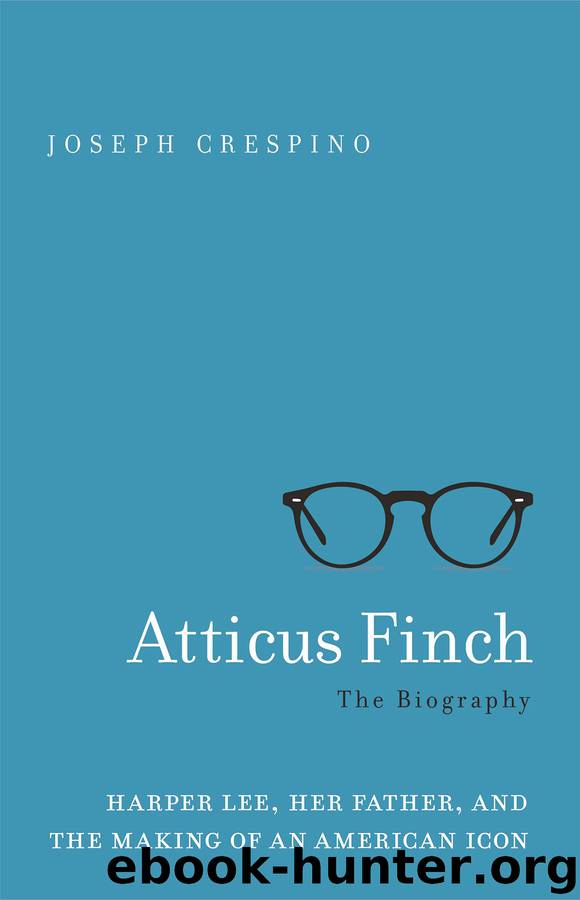
Atticus Finch by Joseph Crespino
Author:Joseph Crespino
Language: eng
Format: epub
Publisher: Basic Books
Published: 2018-05-01T04:00:00+00:00
IN EARLY NOVEMBER 1959, Harper Lee delivered to Annie Laurie Williams the final, revised version of Mockingbird. Soon afterward, Truman Capote contacted her about accompanying him on a research trip. He had come across a brief news item about a mysterious murder in rural Kansas. The Clutter family, the father Herbert, his wife, Bonnie, and two of their children, Nancy, sixteen, and Kenyon, fifteen, had been found murdered in their home outside the small farming community of Holcombe. Capote thought that the story of a small town upended by inexplicable violence could make for an appealing piece of writing. “He said it would be a tremendously involved job and would take two people,” Nelle recalled later. “The crime intrigued him, and I’m intrigued with crime—and, boy, I wanted to go. It was deep calling to deep.” In mid-December, the two of them boarded a train for Kansas.
Thus Nelle was not at home to experience firsthand the events that upended Monroeville that Christmas, and that would summon a bit of the decency in her hometown that she had been trying to imagine in her fiction. The annual Christmas parade had been organized as usual by members of the Kiwanis and Civitan clubs. As they had done for the last seven or eight years, civic leaders had invited the band from Union High School, the local black public school, to march. This meant, of course, that the Monroeville Christmas parade had been racially integrated. Nobody had thought too hard about it—until the Klan did. They paid a visit to the organizers and tried to pressure them into disinviting the Union High band. When the organizers refused, the Klan went directly to the school’s principal. Faced with the prospect of Klansmen assaulting his students on the Monroeville square, he promptly pulled his school’s band out of the event.
Over the past several years white leaders in Monroeville had sat on their hands as the Klan had paraded through black neighborhoods and intimidated white organizations that had included blacks at their meetings. But the idea that the Klan would try to push the town’s leaders around over something as innocent as a Christmas parade was galling to many people. On December 17, the Monroe Journal ran a front-page editorial denouncing the “race hate mongers.” It reflected the racial paternalism that continued to characterize Monroeville’s white elite. “The Negroes can’t fight back,” the Journal noted, “but this newspaper can.” It challenged the Klan to “pick on somebody your size.” Yet it also revealed the consensus that had emerged among Monroe County’s town folk. Civic leaders decided that if the black school’s band couldn’t march, then no one would. They canceled the parade, and began a public relations campaign against the Klan in the pages of the Journal.
The Kiwanis and Civitan clubs published a full-page statement explaining their decision, signed by the membership of both organizations. They thanked their fellow citizens for the outpouring of letters, commendation, and good wishes that they had received since the cancellation. Dozens of Monroe citizens wrote letters supporting the decision.
Download
This site does not store any files on its server. We only index and link to content provided by other sites. Please contact the content providers to delete copyright contents if any and email us, we'll remove relevant links or contents immediately.
Cecilia; Or, Memoirs of an Heiress — Volume 2 by Fanny Burney(31931)
Cecilia; Or, Memoirs of an Heiress — Volume 3 by Fanny Burney(31922)
Fanny Burney by Claire Harman(26588)
We're Going to Need More Wine by Gabrielle Union(19027)
Plagued by Fire by Paul Hendrickson(17395)
All the Missing Girls by Megan Miranda(15904)
Cat's cradle by Kurt Vonnegut(15315)
Bombshells: Glamour Girls of a Lifetime by Sullivan Steve(14042)
For the Love of Europe by Rick Steves(13837)
Leonardo da Vinci by Walter Isaacson(13299)
4 3 2 1: A Novel by Paul Auster(12359)
The remains of the day by Kazuo Ishiguro(8959)
Adultolescence by Gabbie Hanna(8908)
Note to Self by Connor Franta(7660)
Diary of a Player by Brad Paisley(7542)
Giovanni's Room by James Baldwin(7309)
What Does This Button Do? by Bruce Dickinson(6190)
Ego Is the Enemy by Ryan Holiday(5400)
Born a Crime by Trevor Noah(5362)
